As you know, an effective SEO strategy is based on 3 main pillars: improving site content, improving technical performance, and building authority. Building an effective link building strategy is the best way to work on the authority of a website to improve its SEO.
In this article, we are going to review all the elements that will allow you to set up a powerful link building strategy to work on your natural referencing.
What is Link Building and Why is it Important in SEO?
Link building in SEO is the process of acquiring backlinks.
What is a Backlink in SEO?
A backlink is a link from a third-party site pointing to one of your site’s pages.
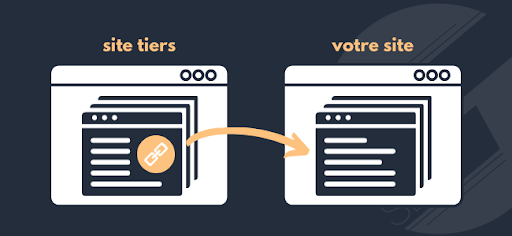
A backlink is a link from a third-party site to your own site. Backlinks are important for building and enhancing the authority of your domain (that is, your website as a whole) with search engines. The more high-quality backlinks you have pointing to your website, the more Google will consider your site high-quality and trusted.
Why are Backlinks Important in SEO?
Before Google’s algorithm became as comprehensive as it is today, the quality of a page was judged solely by its content. Google then launched its PageRank algorithm, which fundamentally changed the way the search engine identifies and ranks web pages.
This evolution has added an external dimension to the analysis of content quality. Google now gives significant weight to the number of external links pointing to pages. With the Google Penguin update, the analysis is more refined. It is no longer enough to have mass backlinks; above all, they must be high-quality. This evolution appeared to counter strategies that artificially create backlinks by buying or integrating mass links on low-quality sites.
Finally, for Google, a backlink acts like a third-party recommendation that can legitimise your expertise on a subject. In SEO, if one of your pages dealing with a specific topic gets a lot of quality backlinks, it will have an extra chance of ranking ahead of competing pages with fewer backlinks or lower quality. The issue of obtaining backlinks is therefore an essential component of an effective natural referencing strategy!
Also Read: Best Omega Indexer Alternatives for URL & Backlink Indexing
How to Identify a Quality Backlink?
It is essential to understand what a good link is before launching a link building strategy. Let’s review the different components of a quality link.
A Quality Backlink Comes from a Page with High Authority Itself
This first point is very logical when we take up the analogy of the recommendation. You trust a recommendation from someone with authority in a field more than an opinion from a stranger (at least I hope).
Google works the same way. For him, if the page and by extension the site of which it is a part has a strong authority, then the “power” of the backlinks emitted is more important. It is often more interesting to obtain a single backlink from a very high-authority site than to obtain a multitude of backlinks from low-authority sites. You can easily check a site’s (often called domain authority) or a page’s authority using online tools like Ahrefs.
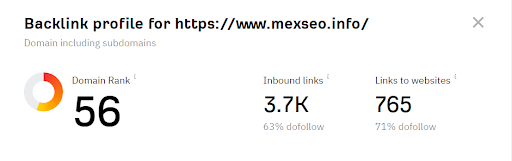
You can know the authority score of the URL, the domain, as well as the number of backlinks of a page. For Google, quality always matters over quantity when it comes to backlinks.
Worse, you could face SEO penalties by acquiring many backlinks from sites Google has identified as “toxic”. That is to say, sites with very low authority, with poor content, poorly optimised technically, insecure…
A Quality Backlink Comes from a Site Dealing with a Similar Theme
The relevance of the third-party site to your theme is an important element in qualifying a backlink. That is, even if you get a link from a high authority site, Google might reduce the “SEO power” of that backlink.
It must be understood that Google analyses activity on the two linked pages to determine whether a backlink is valid.
Let’s take an example:
Vintage guitar maker site A links to guitar string supplier site B and online music lessons site C. Here, the backlinks from sites B and C are relevant because they are on a related theme.
Let’s analyse this second example:
Site A of an accounting firm links to Site B of a tractor manufacturer and Site C of streaming PC games. A priori, the themes of sites B and C differ from those of site A. The backlinks obtained will therefore have a low impact on their authority score.
Illustration of a Good Backlink
It is therefore crucial to work on your link building strategy around referring sites in similar or related fields.
A Quality Backlink is Strategically Positioned on a Page
In your opinion, which backlink will be best perceived by Google: the link placed in one of the first paragraphs of an article or the one placed at the very end of the page, just above the footer? – As you will have understood, when it comes to backlinks, everything is important. And his position is no exception.
In general, a backlink placed in the body of a page will have much more value than one located in a menu, a footer, or in the source at the bottom of the page. This is because Google gives greater weight to contextualised links. That is, links within blocks of text will provide context.
Let’s go back to our example of the vintage guitar maker.
If he includes a backlink to the guitar string maker in a block of text on a page where he touts the quality of his instruments’ strings, then that backlink is well contextualised.
On the other hand, if he makes this backlink on a technical description page listing all the suppliers of materials used to manufacture his guitars without further context, it will have much less impact.
Google’s algorithm is sharp enough to distinguish between an editorial link that serves the topic and a link placed without any real specific purpose.
A Quality Backlink has Good Anchor Text.
Does the anchor text of a link speak to you? – In fact, it is the text that “encloses” a link in a block of text.
Good anchor text contextualises the link. “Click here” or “learn more” are not quality anchor texts. They do not provide any information to Google to help it qualify the link.
For example, all links on this page are contextualised through their anchor text. I have integrated links into coherent sections of text, linking them to the pages they lead to.
Google will analyse the anchor text, the content of page A, and that of page B. If everything is consistent, the link will be considered high-quality. Beyond the anchor text, Google will also analyse the words and phrases around the link. Here again, the more coherence there is, the more qualitative the link will be.
A Quality Backlink has a Dofollow and Nofollow attribute.
There are 2 main link attributes: rel=”nofollow” and rel=”dofollow”.
The nofollow attribute tells Google not to follow that link. Conversely, the dofollow attribute encourages him to follow it.
In reality, the nofollow attribute does not always prevent Google from indexing the page. But from an SEO perspective, the nofollow attribute on a backlink greatly reduces the likelihood that it will confer authority benefits.
Also Read: White Label Link Building Companies
The Best Strategies to Get Quality Backlinks
There are many strategies for acquiring high-quality backlinks without risking Google penalties.
At SLN, we recommend 12 proven best practices for gaining quality backlinks:
- Offer quality content
- Create engaging visuals
- Publish studies/reports
- Dealing with topics in depth
- Send content to influencers
- Do guest blogging
- Communicate on social networks
- Leave relevant comments on the content
- Register in quality directories
- Monitor brand mentions
- Offer content directly
- Spot broken links on a website
Given the nature of the subject, we have dedicated a full article to it, which you can consult at this link:
Should you Buy Backlinks?
We must begin by clarifying that buying links is clearly a violation of Google’s guidelines.
From there, you have a good idea of the answer to this question. But I’ll tell you why that’s a bad idea.
Why is Buying Links a Bad Idea?
You should already know that purchasing links is still extremely widespread.
For what? Even with algorithmic improvements, Google still struggles to distinguish a paid link from a naturally earned one accurately. Another obvious reason is the difficulty in getting those backlinks naturally. It takes a lot of effort, while buying links brings faster results.
On the other hand, keep in mind that buying links involves negative effects:
- By cheating with Google, you expose yourself to significant risks in the event of penalties. The game is not necessarily worth the candle.
- Generally, paid links appear on low-quality sites and cover less coherent themes than naturally earned links.
- If a site offers to pay for backlinks, chances are your competitors have had the same offer.
If you still want to buy links for reasons other than SEO, remember to ask for the rel=”nofollow” or rel=”sponsored” attribute to be added to avoid a negative impact on your SEO.
What Penalties Will Google Inflict on You?
Buying links is a risky SEO tactic, as it involves generating spammy links from sites considered toxic, as seen earlier in this article.
If Google detects that your link building strategy is contrary to its guidelines, you risk a penalty.
They can be issued in 2 ways:
- A manual action, by Google employees
- An automatic algorithmic action (often Google Penguin)
The result? You will see a drop in your ranking in Google. Your pages will be less prominently highlighted by the algorithm when responding to user queries. A manual or automatic action can be remedied by correcting the causes that led to this penalty.
On the other hand, it often takes several months or even sometimes a few years, depending on the case, to recover your initial potential. It is therefore essential to assess the risk-benefit ratio of your actions when seeking to cheat Google, as in the context of link purchases.
In conclusion, do not buy links; instead, favour strategies that help you gain links naturally.
What are the other Benefits of Backlinks?
Generating backlinks is mainly useful for SEO. But a link building strategy also has additional benefits.
Drive Traffic to your Website
Do you use Google Analytics? – If so, you know that there are several traffic acquisition channels (organic, paid, email, social, etc.). One of these channels is the referral. It corresponds to visits to your website made from a click on a link from a third-party site. Basically, it is traffic generated by clicks on backlinks.
Because we must not forget that the interest of a link is, first of all, to allow an Internet user to navigate from page to page, if you have backlinks to a high-traffic site, you can expect some of that traffic to end up visiting your site. More visits to your site can mean more leads, and therefore more customers and sales for you.
Obtaining a backlink from a site with a similar theme and an audience that may be interested in your offer will offer a double advantage. You will improve your SEO while generating qualified visitors to your website. Ideally, these are the types of backlinks you should target first.
Develop Media Relations
When you launch a new product or service, you might be tempted to launch public relations actions. You will contact media sites, influencers in your industry, partners, etc.
In some cases, these contacts will lead to content creation on their respective sites, and you are likely to generate backlinks. These links will benefit your SEO, and you will also build notoriety and trust with these media outlets’ audiences.
You will therefore increase your potential presence in other media that you had not identified, as well as opportunities to make yourself more visible to journalists and editors.
Build your Brand Image
One of the best strategies for generating backlinks is to create quality content around your industry.
For example, if you create a market study, there is a good chance that websites in your theme will talk about it and create links to the page hosting your study.
Ditto for a quality infographic or any other content with very high added value for your market. The generated backlinks will be particularly useful for boosting the SEO performance of the page hosting this quality content.
But it’s also a great way to develop your brand image by highlighting your expertise. It is all the more effective if you evolve in a niche where evangelisation for your activity still needs to be done. Focusing on a certain niche is quite advantageous for improved results. Marketing and promotional efforts in a niche-driven SEO plan are geared toward a specific market segment rather than the entire customer base. With niche-driven SEO, you may rank for your target keywords fast and easily.
How to Measure the Performance of a Link Building Strategy?
As we constantly say at SLN, the key to measuring the success of a marketing action is, first and foremost, defining clear objectives. You need to set achievable goals and avoid focusing solely on quantitative criteria. As we have seen, effective backlinks are, above all, quality backlinks.
A good way to measure the performance of your link building strategy is to compare yourself to the performance of your competitors. Do they have many more backlinks than you? Are they of better quality overall? How does your authority score compare to theirs?
The answers to his questions will help you see things more clearly and avoid focusing solely on vanity metrics. Having 10 times as many links as your main competitor is not useful if those links are not of good quality. They will not bring you benefits in terms of SEO, or even penalise you, as we have seen.
But then, what concrete performance indicators can you track to measure the performance of your link building strategy?
Authority Scores
There are several metrics to track here.
- First, you should track your domain authority. The closer it is to 100, the better. This gives you an indication of the quality of your site’s netlinking profile.
- Next, carefully track the authority scores of your most important pages. These are the pages that must generate the most backlinks, without forgetting the quality of the course.
- Finally, analyse the domain authority of the sites on which you have obtained backlinks. The higher they are, the better your backlinks will be.
Dofollow / Nofollow Link Ratio
As we saw above, nofollow links will have very little impact on your SEO performance.
It is therefore interesting to analyse the proportion of nofollow links compared to your dofollow links. Ideally, you should have more dofollow links than nofollow.
The Number of Referring Domains
It is very unattractive to have a large amount of backlinks from only a handful of sites.
The more referring domains you have, the more qualitative your netlinking profile will be considered by Google.
The Relevance of Themes
We talked about the need for consistency between the pages of the sites that link to each other.
You must therefore ensure that the sites and pages that include your backlinks address topics related to your activity. Thus, your backlinks will be much more effective for SEO.
The Number of Toxic Links
Some tools let you control the quality of the backlinks to your site. It is recommended to identify them and remove them.
Google offers a feature that lets you disavow links you consider toxic. On the other hand, this action must be carried out with caution to avoid harming your SEO.
Also Read: Top SaaS Link Building Agencies
The Volume of Traffic Generated by Your Backlinks
Remember that your backlinks are not only used to improve your site’s authority for SEO purposes. It is also a significant source of traffic that should be monitored and analysed.
You may find that some lower-quality backlinks still drive a high volume of visits, so make sure you don’t lose them.