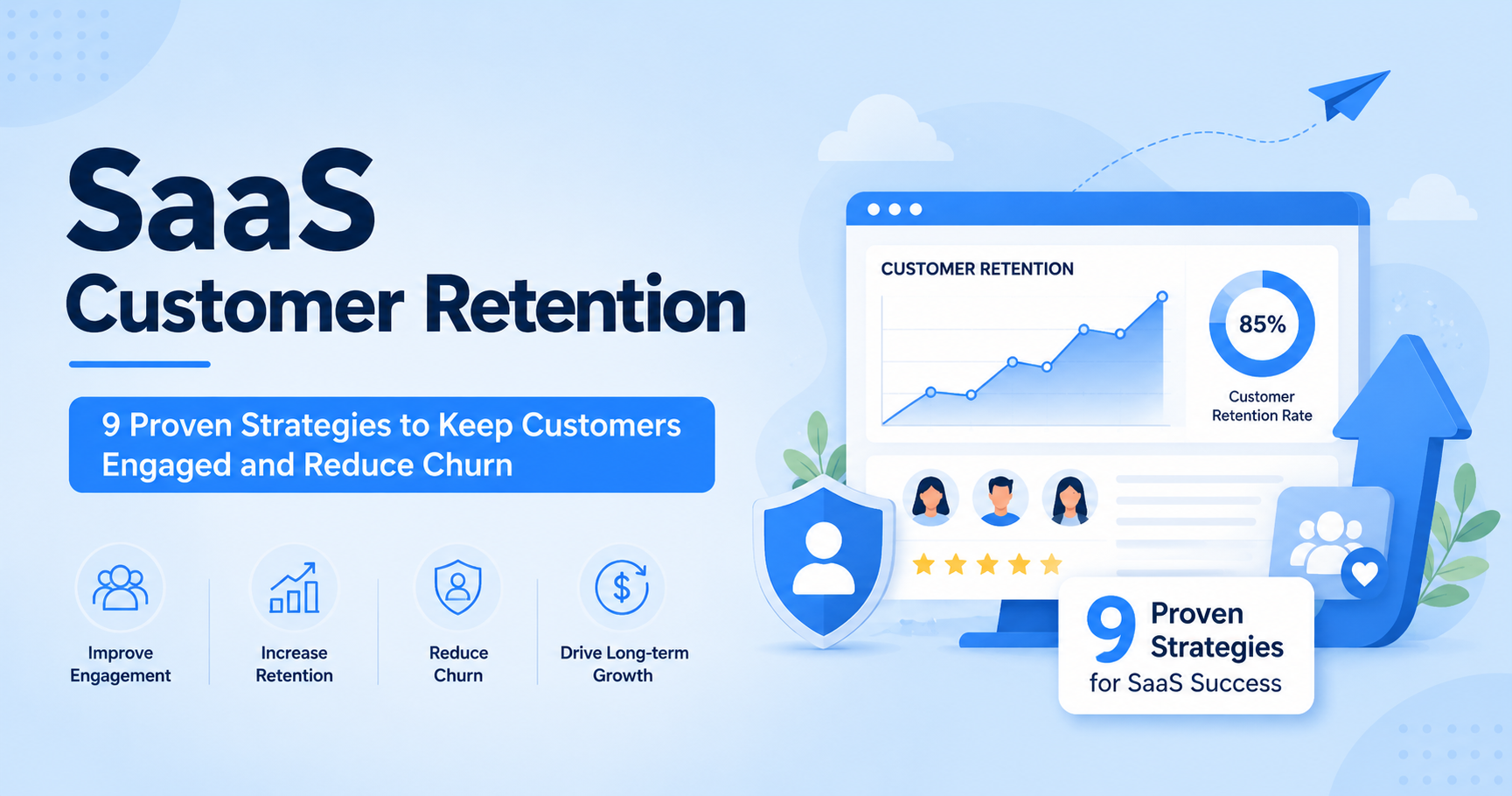
Getting a customer to sign in to your business is just half the job. The more expensive half is keeping them around long enough to actually see value, month after month and renewal after renewal.
Many SaaS businesses spend a great amount of energy on acquisition, but the median B2B SaaS business loses roughly 10% of revenue and logos annually.
That is why customer communication is important as engagement creates perceived value, value creates retention and retention creates long-term revenue.
So, here’s a guide that outlines nine practical, evidence-based methods to improve that chain and several metrics to track in the process.
Why Customer Engagement is Important to Saas Retention?
Recurring-revenue businesses live and die by one particular question : Is the customer getting sufficient value to keep them paying?
Unlike a one-time purchase model, SaaS revenue depends completely on customer retention. The very best proof for this value is the active product usage and consistent feature adoption.
Engagement drops are never random. Reduced logins, declining feature usage or a team not inviting new members are all warning signs of customer churn.
Improve Onboarding & Reduce Time-to-value
The very first 90 days typically decide everything. Data show this window drives 60% to 70% of an annual churn for any SaaS firm, making early onboarding possibly the most leveraged retention lever.
The goal is simple: Get new customers to their first real outcome as soon as possible. Guided setup flows, interactive checklists, short tutorials and contextual in-app assistant all shorten that path.
Without that milestone, successful onboarding is simply a vague guess instead of a measurable objective.
Personalize the Customer Experience
Not all customers use the product the same way, so treating them identically is a waste of opportunity.
Segmenting customers by role, use case, behaviour or actual product usage enables teams to customize onboarding flows, feature recommendations and communications to each group’s requirements.
So, behavioral personalization lets adjust messaging based on what a customer has actually done inside the product, which consistently outperforms generic, one-size-fits-all messaging as it reflects genuine intent rather than assumptions.
Use In-app Messaging to Keep Customers Engaged
Customers shouldn’t have to abandon a product just to get help or ask a question. Every context switch, every new tab opened, every search for a support email generates friction and increases the chances that a minor issue will become irritating.
Embedding communication solution capabilities directly into the product keeps customers engaged instead of forcing them elsewhere. This is helpful for support conversations, context-aware product help, team collaboration in shared workspaces and real time notifications for specific in-app actions.
This differs from a normal live chat widget on a website which lives outside the actual product experience and out of context with users. While embedded, in-app messaging is tied to what the customer does.
To do this you don’t need to build a chat system from the ground up. MirrorFly’s Chat API/SDK is a quick way to carry out real time messaging in an existing application without months of backend engineering work.
It offers self-hosted and white-label chat APIs and SDKs to allow SaaS teams to integrate one-to-one, group messaging, file sharing or notifications directly into their very own product. Also, it’s on-premise deployment model makes it ideal for businesses with more stringent data control and compliance requirements.
Move From Reactive to Proactive Customer Support
Reactive Support is waiting for a customer to open a ticket. Proactive support will attempt to catch the problem prior to the ticket being written. The difference is more important than you may think, since by the time the customer calls, frustration has built up.
Some situations always call for proactive outreach: a new user stuck mid-onboarding, a customer repeatedly hitting exactly the same feature error, confusion around a recently released capability, or a sudden decline in use from a previously active account.
Seeing those moments and also reaching out first before annoyance turns into disengagement is often what separates the saved account from the lost one.
Keep Educating Customers After Onboarding
Education must not stop once onboarding is complete. Customers who learn just the basics eventually plateau and never find the deeper functionality that makes the product genuinely sticky.
Live tutorials, searchable knowledge base, detailed product guides and targeted feature education help customers discover capabilities they did not know were available.
This directly supports feature adoption for long-term retention, because customers who use more of the product’s depth are not as likely to think of it as replaceable.
Develop a Continuous Customer Feedback Loop
Collecting Feedback is productive, but surveys left in a spreadsheet do little to enhance retention. The value is only shown if feedback changes something. A simple framework is useful here: Collect, analyse, act & communicate.
Gather input consistently using NPS & CSAT scores, customer interviews, structured surveys, feature requests & in-app feedback prompts.
Analyze the same for patterns, act on what pops up repeatedly and finally inform customers what changed due to their input.
Communicating back is what changes feedback from a data collection exercise to a trust building exercise.
Identify Churn Signals Before Customers Leave
Waiting for a cancellation email is never the right approach. The better approach is focusing on behavioral cues that generally come weeks or months before somebody leaves:
- Decreasing login or activity frequency.
- Compare historic patterns.
- Less use of core, high-value features.
- Incomplete onboarding steps.
- Decreasing team or multiuser activity.
- Increasing support tickets and repeated issues.
- Less engagement with workflows tied to the product’s value.
None of these signals will ensure churn, but when combined can provide an actionable picture. Teams which develop systems to spot these patterns early can provide targeted interventions, a check-in call, a personalized tutorial or a proactive discount before the customer has mentally left. Most of those systems run on behavioral analytics, which flags the drop in logins or feature use before a customer ever hints at leaving.
Build a Customer Community
Retention doesn’t depend on product alone, but also on the relationship customers have built around it.
A community be it a user forum, Slack channel, local meetups or yearly events provide customers a reason to stay connected and look beyond its feature set.
The peer discussions on it lets customers learn tricks and workflows they might not pick up from documentation alone and that expertise produces an emotional investment.
A customer who participates in a community, shares tips or answers questions from other users creates trust and reliability, more than a customer who simply uses the product alone.
Provide Customers Reasons to Keep Using the Product
Long-term retention depends on customers repeatedly rediscovering value, not simply recalling the value they found on day one.
This should go beyond announcing new features and show customers how to connect them to their workflows.
Relevant new releases, advanced workflow options, third party integrations, personalized recommendations based on usage, visible product milestones and new use cases provide customers fresh reasons to remain engaged.
Companies that do this well consider feature discovery as an ongoing job and not a one-time onboarding task.
Saas Customer Retention Metrics to Track
A few metrics tell the entire story that is worth looking out for:
| Metric |
What it tells you |
|---|---|
| Customer retention rate |
How many customers remain over a given period |
| Churn rate |
How many customers are leaving, and how fast |
| Activation rate |
Whether new users actually reach initial value |
| Feature adoption |
Whether customers use the functionality that matters most |
| DAU/WAU/MAU |
How actively customers are engaging with the product day to day |
| NPS/CSAT |
Overall customer sentiment and satisfaction |
By way of context
- A median B2B SaaS company holds a SaaS retention rate of 88% to 90% annually.
- Enterprise-focused providers generally reach 90% to 95%.
- SMB-focused self-serve products between 70% and 85%.
Customer lifetime value (CLV) is also well worth tracking briefly as it links retention to the revenue impact.
Final Verdict
A clever tactic alone doesn’t result in long-term SaaS customer retention. It is accomplished by stacking onboarding, personalization, proactive support, continual education, feedback loops, community, continuous value delivery and more.
No single fix makes up for broken onboarding flow or even missed feedback. The very best start is to identify where engagement ends on your customer journey and focus on the strategies closest to that drop-off-rather than attempting to do all at once.
Faqs
What is SaaS customer retention?
It’s how a SaaS provider can keep existing customers signed up and make use of the product over time without losing them to cancellation or non-renewal.
How can SaaS businesses reduce customer churn?
By enhancing onboarding speed, personalizing the experience, proactive support, keeping ongoing education and acting on customer feedback consistently instead of sporadically.
What are the most effective SaaS customer retention strategies?
Fast time to value onboarding, behavioral personalization, in-app communication, hands-on assistance and early identification of churn signals have the greatest measurable impact.
How does customer engagement affect SaaS retention?
Engagement is often the very first indicator of retention outcomes. Customers who log in often and use core features consistently have a lower churn rate than customers whose usage is declining.
How can SaaS companies identify customers at risk of churning?
By monitoring behavioral signals like declining logins, reduced feature use, incomplete onboarding, and increasing support tickets, they identify them and trigger targeted outreach before cancellation happens.
Terms in this guide