Backlink indexers promise to get the pages that link to you indexed by Google, so those links start to count. A backlink indexer can at best nudge a crawler to visit. Google still decides whether the page is worth keeping, so a thin, blocked or spammy linking page stays out, and some indexing methods add risk.
What helps most happens earlier: earn links on pages Google already wants to index, then check the few that matter.
This guide shows you how to tell which unindexed links are worth chasing, how to test a tool fairly if you still want to try one, and what to do instead.
What is a backlink indexer?
A backlink indexer is a paid service that takes a list of URLs, usually the pages carrying your backlinks, and tries to get search engines to crawl them. Vendors use a handful of methods: listing the URLs in feeds or sitemaps they host, pinging search engines, or building extra links that point at your linking pages. Most charge per URL or sell credit packs.
None of these methods gives a third party access to Google’s own indexing request. Only a verified owner of the site can use that request.
Why does an unindexed linking page matter?
A backlink can only pass value once Google has crawled and indexed the page it sits on. A link on a page Google never indexed counts for nothing. That is the one true claim behind every indexer pitch.
Indexing is only the first filter. Google treats a nofollow link as a hint rather than a vote, and it weighs how relevant and trusted the linking page is. An indexed link is not automatically a useful one.
Why do some backlink pages never get indexed?
Most linking pages stay out of Google’s index for one of six ordinary reasons, and an indexer can affect only two of them.
| Reason the page is not indexed | Can an indexer help? | What actually helps |
|---|---|---|
| Thin or low-value page | No | Get your next link on a stronger page |
| Duplicate or copied content | No | Nothing on your side: Google keeps one version |
| Noindex tag or robots.txt block | No | Ask the site owner, or accept the link won’t count |
| Orphan page with no internal links | Sometimes, by creating a path to it | A link to it from the site’s category or archive page |
| New or rarely crawled site | Sometimes, by speeding up a first visit | Time, or links from sites Google crawls often |
| Server errors or content that loads only through scripts | No | The site owner fixes the technical problem |
The table shows the limit: an indexer helps with discovery, and discovery is rarely the problem. A page Google has judged not worth indexing stays out. A page that gets in for a day can drop out again.
What can Google’s own tools do for indexing?
Google gives site owners free ways to get their own pages crawled, and none of them works for a page on someone else’s site. That gap is why backlink indexers exist. It is also why they can’t use Google’s official routes for you.
| Method | Who can use it | Works for backlink pages on other sites? |
|---|---|---|
| XML sitemap submitted in Search Console | The verified owner of the site | No |
| URL Inspection, “Request indexing” | The verified owner, within a daily quota | No |
| Indexing API | Only pages with job posting or livestream structured data | No |
| IndexNow | A site owner who hosts a key file on the domain | No, and Google does not use it |
| Sitemap ping | Nobody: Google retired its ping endpoint in 2023 | No |
Google describes the sitemap and URL Inspection routes in its guide to asking Google to recrawl your URLs. You manage both from Google Search Console.
Google’s Indexing API documentation limits the API to job postings and livestream videos. A service that pushes ordinary pages through it is using the API outside its purpose.
IndexNow notifies Bing, Yandex and other participating engines, so it can speed up Bing for your own pages. It does nothing for Google.
Do backlink indexing tools work?
Backlink indexers work for discovery and rarely for lasting indexing. Vendors quote success rates, but those figures come from the vendors themselves. “Indexed” can also mean a page appeared once and then dropped out.
Pages that deserve indexing usually get there without help. Pages that don’t rarely stay.
Some services also rely on mass pinging or throwaway links aimed at your linking pages. That adds no value and leaves a footprint that looks like manipulation.
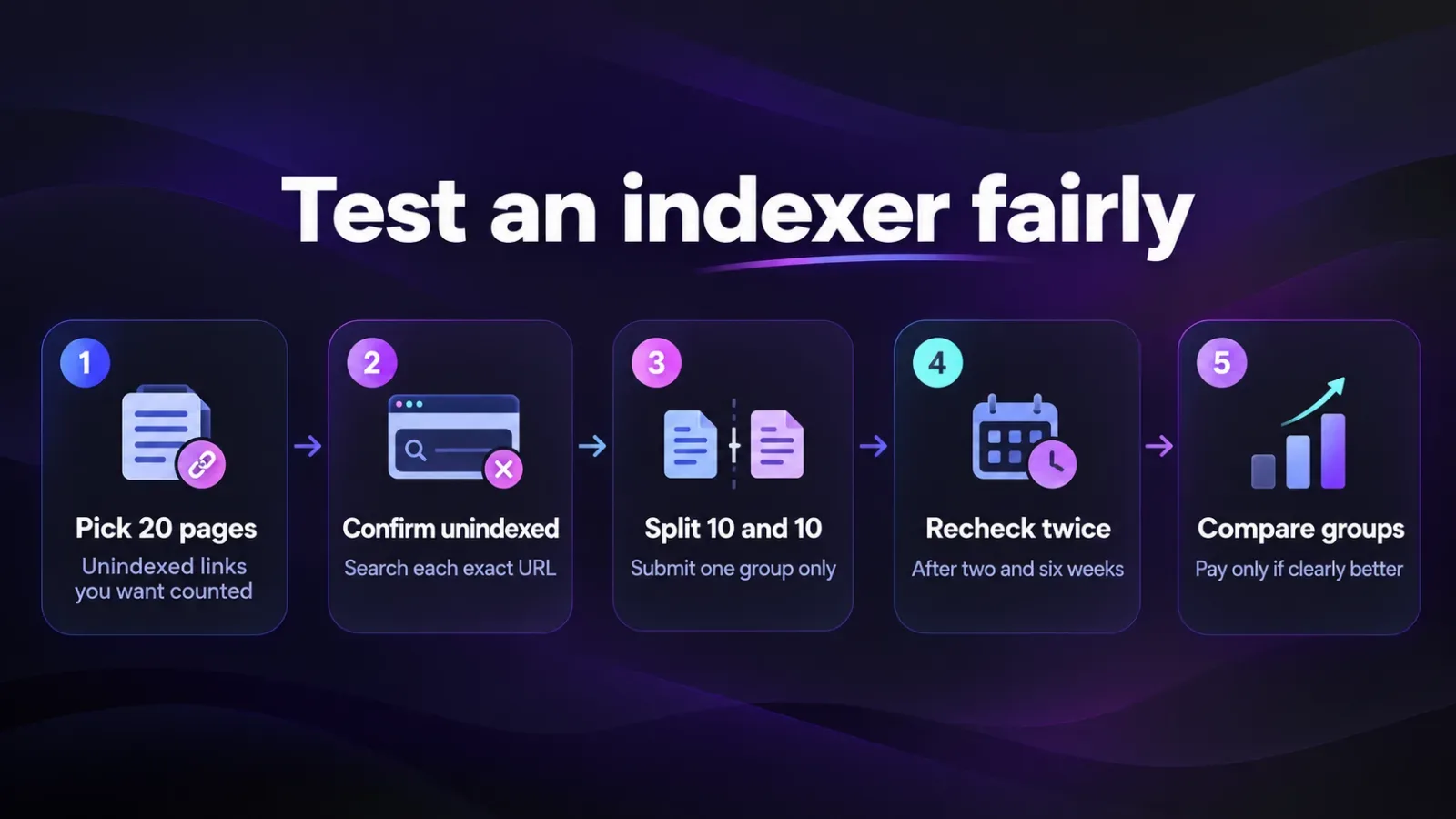
If you still want to try a backlink indexer, run a small test with a control group so the result means something.
- Pick 20 unindexed linking pages that you want counted.
- Confirm each one is unindexed by searching for its exact URL.
- Split them into two groups of 10 and submit only one group to the indexer.
- Recheck both groups after two weeks and again after six weeks.
- Buy more credits only if the submitted group stays indexed clearly more often than the control group.
Want to compare specific services before testing? Our overview of Omega Indexer alternatives covers the main options.
Safer ways to get linked pages discovered
Indexing of your linking pages mostly follows from where your links sit. These seven habits do more than any credit pack.
- Earn links on real sites that Google crawls often, using a quality-first backlink strategy.
- Ask the linking site to link the article from a category, archive or related-posts page.
- Submit your own pages in a sitemap and request indexing in Search Console for the important ones.
- Fix noindex tags, robots.txt rules and server errors on pages you control.
- Give a new link a few weeks before you act, because Google’s recrawl guide says crawling can take a few days to a few weeks.
- Review your link profile every few months to spot weak links worth replacing.
- For a local business, pursue links from local press, suppliers and trade associations, as our guide to backlinks for local SEO explains.
How to check whether a backlink page is indexed
Checking a linking page takes a minute. Each of these three methods has a blind spot.
- Search Google for the page’s exact URL in quotes, or use the
site:operator with the full URL. Treat a missing result as a warning sign rather than proof, because site: results are not complete. - If you own the page, the URL Inspection tool in Search Console gives Google’s own answer.
- Backlink tools such as Ahrefs, Semrush and Majestic show the links their own crawlers found. That tells you nothing about Google’s index.
What are the risks of backlink indexers?
Backlink indexers carry four risks, and the biggest depends on which links you feed them.
- Indexing bought or swapped links draws attention to a pattern that Google’s spam policies already treat as link spam.
- Services that build throwaway pages or private blog network links to your linking pages add spam to your profile.
- Credits are spent whether or not the page stays in the index.
- Uploading your backlink list hands a third party a map of your link building.
When is a backlink indexer worth testing?
A backlink indexer is worth testing only when a good link sits on a decent page that Google hasn’t found yet. In every other situation, put your money elsewhere. If you’re unsure which kind of link you have, our comparison of low-quality and high-quality backlinks helps you sort them.
| Your situation | What to do |
|---|---|
| A strong, relevant site links to you from a page with no internal links | Ask the owner to link that page from a crawled page |
| The link sits on a thin directory or a bought post with exact-match anchor text | Don’t index it. Replace it with a better link |
| The linking page has a noindex tag or is blocked | Accept that it won’t count |
| Dozens of decent but rarely crawled sites link to you | Run the control-group test above before paying for more |
| Most of your links never get indexed | Change how you build links, not how you index them |
Sort your unindexed links before you buy credits
This week, export the links you’ve earned in the last three months and check the ten that matter most. Place each one in the table above.
If weak sites cause most of your problem, the budget belongs in better links, not indexing credits. MexSEO builds links by earning them as part of its SEO services. Send an enquiry and we’ll reply with a written proposal.
Frequently asked questions
Is IndexNow a backlink indexer?
No. IndexNow is a protocol that lets a site owner tell Bing, Yandex and other participating engines about changed URLs on their own site. Each submission needs a key file hosted on that domain, so you can’t use IndexNow for a page on someone else’s site. Google does not use IndexNow.
How long does it take for a backlink to be indexed?
A backlink usually gets indexed within a few days to a few weeks, depending on how often Google crawls the linking site. Pages on large news sites can show up within hours. If a linking page is still missing after six weeks, Google has most likely decided it isn’t worth indexing.
Can I force Google to index a page?
No. You can request indexing for pages on a site you’ve verified in Search Console, and Google still decides whether to index them. No paid service can get around that decision.
Should I disavow backlinks that never get indexed?
No. A link on an unindexed page passes nothing, so there is nothing to disavow. Disavowing links is meant for harmful links you can’t get removed, and Google’s Search Console help says most sites never need it.
Why is my page crawled but not indexed?
Search Console reports a page as crawled but not indexed when Google has visited it and chosen to leave it out, often because the content is thin or duplicated. Requesting indexing again rarely changes the outcome. On your own site, improve the page first. For a backlink on someone else’s site, accept the page as it is and earn your next link elsewhere.
Terms in this guide